Characterization and Cartesian Product of Smarandache Semigroups (S-semigroups)
Article Sidebar
Main Article Content
Abstract
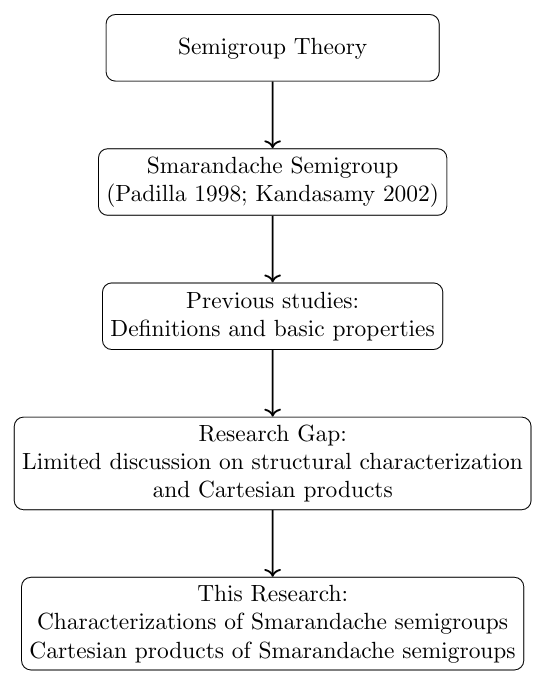
Let (S, *) be a semigroup. A semigroup S is called a Smarandache semigroup (or S-semigroup) if it contains a proper subset A ⊂ S such that (A, *) forms a group under the same binary operation defined on S. In general, not every semigroup admits a proper subset that is a group; hence, not all semigroups are S-semigroups. In this paper, several structural conditions related to Smarandache semigroups are investigated. In particular, we study the role of idempotent and completely regular elements in the structure of S-semigroups. These conditions provide a characterization of S-semigroups. Furthermore, this study investigates whether the Cartesian product of two or more S-semigroups is again an S-semigroup.
Article Details
References
[1] John M. Howie. Fundamentals of Semigroup Theory. Oxford University Press, 1995.
[2] Raul Padilla. Smarandache algebraic structure. Bulletin of Pure and Applied Sciences, 17E:119–121, 1998.
[3] S. Suganya. Smarandache anti q-fuzzy semigroups. International Journal of Mathematics Trends and Technology, 60(5):340–346, 2018.
[4] Parween A. Hummadi and Pishtewa M. Dashtiy. On smarandache semigroups. Journal of Kirkuk University–Scientific Studies, 6(1):91–100, 2011.
[5] W. B. Vasantha Kandasamy. Smarandache Semigroups. American Research Press, 2002.
[6] David S. Dummit and Richard M. Foote. Abstract Algebra. John Wiley & Sons, New York, 3rd edition, 2014.
[7] I. N. Herstein. Abstract Algebra. Prentice Hall, New York, 3rd edition, 1996.
[8] John M. Howie. Introduction to Semigroup Theory. Academic Press, 1976.
[9] Tero Harju. Semigroups. 1996. [Online; accessed 13-March-2026].
[10] Sukirman and S. Sebagyo. Struktur Aljabar. 1999.
[11] Linda Gilbert and Jimmie Gilbert. Elements of Modern Algebra. Brooks, USA, 2008.
[12] Joseph J. Rotman. Advanced Modern Algebra. Prentice Hall, New Jersey, 2003.
[13] John B. Fraleigh. A First Course in Abstract Algebra. Pearson Education, USA, 7th edition, 2014.
[14] Joseph A. Gallian. Contemporary Abstract Algebra. Addison-Wesley Publishing Company, New York, 2012.