
Confidence Interval Estimation of Linear Model Parameter Ratios Via Fieller’s Method Under Heteroscedasticity Using Weighted Least Squares (Simulation Study)
Article Sidebar
Main Article Content
Abstract
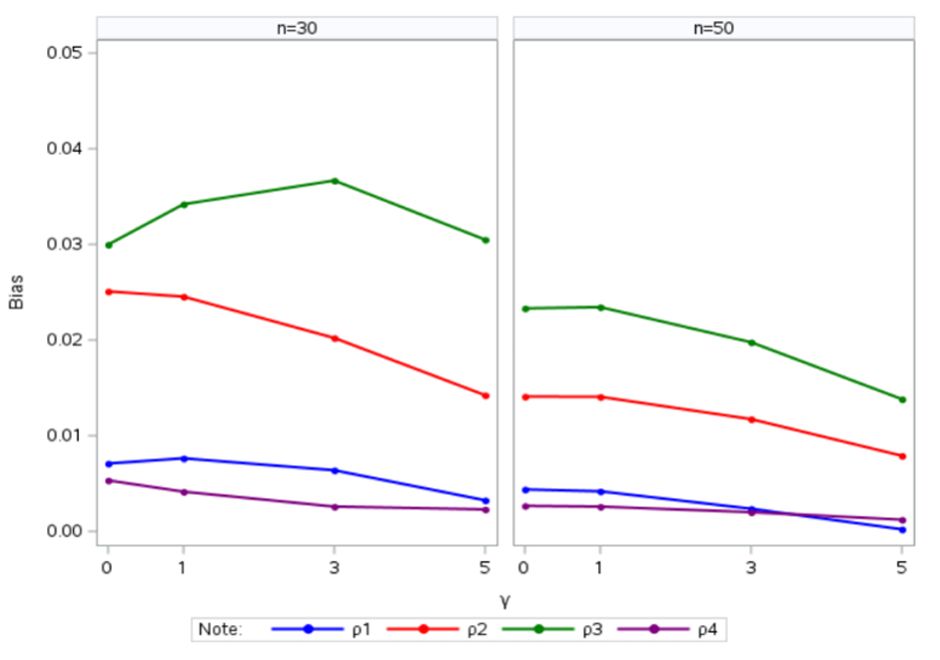
Heteroskedasticity in linear models is a common problem that can cause parameter estimators to become inefficient and the estimation of the variance-covariance matrix to become inconsistent. This condition leads to incorrect and inaccurate statistical inference, including the construction of confidence intervals. Confidence interval estimation is not only performed for a single parameter but can also involve ratios, in which the Fieller method is commonly used for constructing confidence intervals for parameter ratios in linear models. This study examines the estimation of confidence intervals for parameter ratios using the Fieller method under heteroskedastic conditions by applying the Weighted Least Squares (WLS) method. Through simulations with variations in heteroskedasticity levels of λ = 0, 1, 3, and 5 and sample sizes of n = 30 and n = 50, the performance of the method was evaluated based on bias, Coverage Probability (CP), and Average Length (AL). The results show that the WLS method produces unbiased parameter estimators at all levels of heteroskedasticity. In addition, the Fieller method produces CP values around 0.95 with only small fluctuations and tends to yield shorter AL values. Therefore, the combination of the WLS and Fieller methods is proven to be stable and efficient for parameter estimation and confidence interval estimation of parameter ratios under heteroskedastic conditions.
Article Details
References
[1] Mustofa Usman and Warsono. Teori Model Linear dan Aplikasinya. Sinar Baru Algansindo, 2009.
[2] Ivan Jacob Agaloos Pesigan and Shu Fai Cheung. Monte Carlo Confidence Intervals for the Indirect Effect with Missing Data. Behavior Research Methods, 56(3):1678–1696, 2024.
[3] Syarli Dita Anjani, Bernadhita Herindri Samodera Utami, Mustofa Usman, Vitri Aprilla Handayani, et al. Geographically Weighted Ridge Regression Modelling on 2023 Poverty Indicators Data in the Provinces of West Kalimantan and Central Kalimantan. Integra: Journal of Integrated Mathematics and Computer Science, 1(3):73–80, 2024.
[4] Raymond H. Myers and J. Susan Milton. A First Course in the Theory of Linear Statistical Models. McGraw-Hill, New York, 1991.
[5] L. Singhasomboon, W. Panichkitkosolkul, and A. Volodin. Confidence Intervals for the Ratio of Means of Two Independent Log-Normal Distributions. WSEAS Transactions on Mathematics, 20:45–52, 2021.
[6] Chandima N. P. G. Arachchige and Luke A. Prendergast. Confidence Intervals for Median Absolute Deviations. Communications in Statistics—Simulation and Computation, 55(1):13–22, 2026.
[7] Owen McGrath and Kevin Burke. Binomial Confidence Intervals for Rare Events: Importance of Defining Margin of Error Relative to Magnitude of Proportion. The American Statistician, 78(4):437–449, 2024.
[8] Bret A. Holladay and Mark F. Schilling. Short Confidence Intervals for the Count Parameters of the Binomial, Negative Binomial, and Hypergeometric Distributions. Communications in Statistics—Theory and Methods, 54(17):5428–5442, 2025.
[9] Chao Chen, Wenchen Tan, Zhigang Huang, Jinlin Du, Haibing Yu, and Haiyan Pan. Recommended Confidence Intervals for the Conditional Odds Ratio in Matched-Pairs Designs. Journal of Biopharmaceutical Statistics, 31(3):339–351, 2021.
[10] Kristina Veljkovic. Comparing Confidence Intervals for the Mean of Symmetric and Skewed Distributions. Symmetry, 16(11):1424, 2024.
[11] Joe Hirschberg and Jenny N. Lye. Providing Intuition to the Fieller Method with Two Geometric Representations Using STATA and EViews. SSRN Electronic Journal, 2007.
[12] Warisa Thangjai and Sa-Aat Niwitpong. The Relative Potency of Two Drugs Using the Confidence Interval for the Ratio of Means of Two Normal Populations with Unknown Coefficients of Variation. Journal of Statistics Applications & Probability, 11(1):1–14, 2022.
[13] Patarawan Sangnawakij. Regression-in-Ratio Estimator and Confidence Interval for the Population Mean for Data with Outliers. Science & Technology Asia, 27(2):42–57, 2022.
[14] Laurence S. Freedman. Confidence Intervals and Statistical Power of the Validation Ratio for Surrogate or Intermediate Endpoints. Journal of Statistical Planning and Inference, 96(1):143–153, 2001.
[15] Zaka Ratsimalahelo. Re-Examining Confidence Intervals for Ratios of Parameters. Econometrics, 13(3):37, 2025.
[16] Jean-Marie Dufour, Emmanuel Flachaire, Lynda Khalaf, and Abdallah Zalghout. Identification-Robust Methods for Comparing Inequality with an Application to Regional Disparities. The Journal of Economic Inequality, 22(2):433–452, 2024.
[17] Xiaowei Peng, Chengfeng Lei, and Xiulian Sun. Comparison of Lethal Doses Calculated Using Logit/Probit Log(Dose) Regressions with Arbitrary Slopes Using R. Journal of Economic Entomology, 114(3):1345–1352, 2021.
[18] Peng Wang, Siqi Xu, Yi-Xin Wang, Baolin Wu, Wing Kam Fung, Guimin Gao, Zhijiang Liang, and Nianjun Liu. Penalized Fieller's Confidence Interval for the Ratio of Bivariate Normal Means. Biometrics, 77(4):1355–1368, 2021.
[19] Gary O. Zerbe. On Fieller's Theorem and the General Linear Model. The American Statistician, 32(3):103–105, 1978.
[20] F. Virgantari, M. Widyastiti, and N. Ir Seno. Comparison of Weights in Weighted Least Square Method for Handling Heteroscedasticity on Multiple Regression Model. International Journal of Mathematics, Statistics and Computing, 2(2):60–67, 2024.
[21] Felinda Arumningtyas, Bambang Widjanarko Otok, and Santi Wulan Purnami. Random Effects Meta-Regression Using Weighted Least Squares (Case Study: Effectiveness of Acceptance and Commitment Therapy in Reducing Depression). Media Statistika, 18(1):49–60, 2025.
[22] Jörgen Blomvall, Pontus Söderbäck, and Martin Singull. Weighted Least Squares Estimation of the Risk-Free Rate from Derivative Prices. Communications in Statistics: Case Studies, Data Analysis and Applications, 9(1):72–105, 2023.
[23] Hidayatun Nisa and Dadan Kusnandar. Estimasi Parameter Metode Weighted Least Squares Dalam Mengatasi Masalah Heteroskedastisitas. Buletin Ilmiah Matematika, Statistika dan Terapannya (BIMASTER), 9(1):65–70, 2020.
[24] Agnalia Sintasya Putri and Armayani Arsal. Regresi Robust Method of Moment dan Weighted Least Square Dalam Mengatasi Masalah Pencilan dan Heterokedastisitas (Studi Kasus: Tingkat Pengangguran Terbuka di Indonesia Tahun 2022). Research Review: Jurnal Ilmiah Multidisiplin, 4(1):55–62, 2025.
[25] Yijun Zuo and Hanwen Zuo. Weighted Least Squares Regression with the Best Robustness and High Computability. Axioms, 13(5):295, 2024.
[26] Muhammad Ferdiansyah, Raupong Raupong, and Siswanto Siswanto. Panel Data Regression Modeling with Weighted Least Squares Method Using Fair Weights. Jurnal Varian, 8(2):179–188, 2025.
[27] Martin Sterchi and Michael Wolf. Weighted Least Squares and Adaptive Least Squares: Further Empirical Evidence. In *Robustness in Econometrics*, pages 135–167. Springer, 2017.
[28] Nianbo Dong, Rebecca A. Maynard, Benjamin Kelcey, Jessaca Spybrook, Wei Li, A. Brooks Bowden, and Dung Pham. Advantages of Monte Carlo Confidence Intervals for Incremental Cost-Effectiveness Ratios: A Comparison of Five Methods. Journal of Research on Educational Effectiveness, 18(4):951–979, 2025.
[29] J. I. Daoud, M. Usman, A. M. Elfaki, R. Othman, and A. Sidiq. Transformation of a Constrained Model into an Unconstrained Model in Two-Way Treatment Structure with Interaction. Quantitative Methods, 2(2):29–36, 2006.