
Application of Linear Side Conditions Tβ=0 on Non-Full Rank Linear Models
Article Sidebar
Main Article Content
Abstract
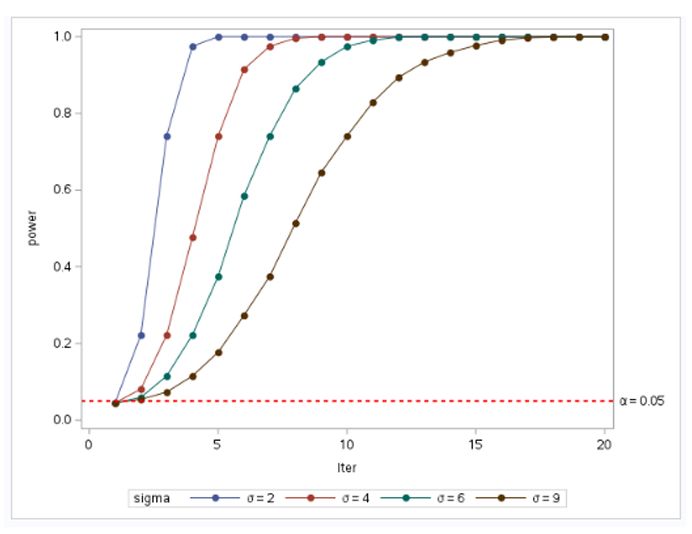
Linear model is one of the foundation of statistical analysis, including analysis of variance (ANOVA). However, under non-full rank conditions, the design matrix exhibits linear depen dence, preventing the unique estimation of model parameters. This study aims to address this issue and to cope the problem by applying side conditions in the form of the linear constraint TB=0 without altering the model structure. The methods employed include the formulation of a restricted linear model, the derivation of parameter estimators, and simulation studies. The results show that side conditions produce unique, stable, and nearly unbiased parameter estimators. Furthermore, the results indicate that the power of test increases as differences between parameters increase and decreases as the variance of the error term increases. Thus, this approach is effective in ensuring the uniqueness of parameter estimates and improving the quality of analysis in ANOVA models with non-full rank design matrices.
Article Details
References
[1] G. A. Milliken and D. E. Johnson. Analysis of Messy Data, Volume 1: Designed Experiments. Chapman & Hall/CRC, Boca Raton, 2009.
[2] D. C. Montgomery. Design and Analysis of Experiments. John Wiley & Sons, Hoboken, 2013.
[3] A. C. Rencher and G. B. Schaalje. Linear Models in Statistics. John Wiley & Sons, Hoboken, 2008.
[4] M. Usman and Warsono. Teori Model Linear dan Aplikasinya. Sinar Baru Algesindo, Bandung, 2009.
[5] G. A. F. Seber. The Linear Model and Hypothesis: A General Unifying Theory. Springer, Cham, 2015.
[6] J. G. Hirschberg and D. J. Slottje. The Reparameterization of Linear Models Subject to Exact Linear Restrictions. Department of Economics, University of Melbourne & Southern Methodist University, Melbourne, 1999.
[7] J. A. John. Use of generalized inverse matrices in MANOVA. Journal of the Royal Statistical Society: Series B, 32(1):137–143, 1970.
[8] M. P. Little, W. F. Heidenreich, and G. Li. Parameter identifiability and redundancy: Theoretical considerations. PLoS ONE, 5(1):1–6, 2010.
[9] M. A. Murray-Lasso. Alternative methods of calculation of the pseudo inverse of a non full-rank matrix. Journal of Applied Research and Technology, 6(3):170–183, 2008.
[10] S. G. Wang and S. C. Chow. Advanced Linear Models: Theory and Applications. Chapman & Hall/CRC, Boca Raton, 2007.
[11] A. Darghan, S. Surendra, and J. Monroy. A score test for the agronomical overlap effect in a two-way classification model. Agronomía Colombiana, 32(3):417–422, 2014.
[12] A. Hector, S. von Felten, and B. Schmid. Analysis of variance with unbalanced data: an update for ecology & evolution. Journal of Animal Ecology, 79(2):308–316, 2010.
[13] J. A. Nelder. The statistics of linear models: back to basics. Statistics and Computing, 4:221–234, 1994.
[14] R. L. Plackett. Some theorems in least squares. Biometrika, 37(1/2):149–157, 1950.
[15] D. W. Seegrist. Least squares analysis of experimental design models by augmenting the data with side conditions. Technometrics, 15(3):643–645, 1973.
[16] B. R. Clarke. Linear Models: The Theory and Application of Analysis of Variance. John Wiley & Sons, Hoboken, 2008.
[17] R. H. Myers and J. S. Milton. A First Course in the Theory of Linear Statistical Models. John Wiley & Sons, New York, n.d.
[18] D. A. Harville. Linear Models and the Relevant Distributions and Matrix Algebra. CRC Press, 2018.
[19] D. A. Harville. Matrix Algebra: From a Statistician's Perspective. Springer, New York, 2008.
[20] D. L. Zimmerman. Linear Model Theory: With Examples and Exercises. Springer Nature, 2020.
[21] R. E. Walpole, R. H. Myers, S. L. Myers, and K. Ye. Probability & Statistics for Engineers & Scientists. Pearson Education, Boston, 9 edition, 2012.