
The Use of Model Reduction Method in the Combined Analysis of Two Randomized Complete Block Designs
Article Sidebar
Main Article Content
Abstract
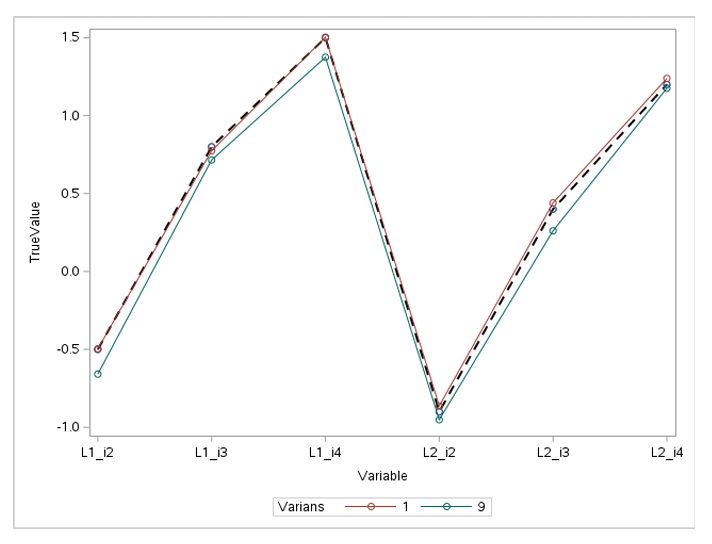
Randomized Complete Block Design (RCBD) is an experimental design frequently used to control variability due to confounding factors. This design groups experimental units into relatively homogeneous blocks. However, the RCBD mathematical model contains linear constraints on the treatment and block effect parameters, which causes the design matrix to be non-full rank. Structural problems become more complex when combining two RCBD models in one analytical framework to expand information. This study applies the Model Reduction Method (MRM) to the combination of two RCBD models, focusing on the formation of a full rank model, parameter estimation using the Least Squares method, and evaluation of the estimator properties based on the Best Linear Unbiased Estimator (BLUE) criteria. This study also includes simulations using SAS 9.4 software to assess the performance of parameter estimation and hypothesis testing. The results demonstrate that MRM is effective in transforming a non-full rank model into a full rank model. Parameter estimation in the full rank model produces an estimator that is unbiased and has minimum variance, in accordance with the BLUE criteria. The results of the hypothesis testing show that the model obtained has good test power under low error variance conditions, and continues to show consistent performance reaching a value of one under all error variance conditions as the parameter distribution increases.
Article Details
References
[1] Annette J. Dobson and Adrian G. Barnett. An Introduction to Generalized Linear Models. Chapman and Hall/CRC, Boca Raton, 4 edition, 2018.
[2] John Fox. Applied Regression Analysis and Generalized Linear Models. SAGE Publications, Thousand Oaks, 3 edition, 2015.
[3] Ronald R. Hocking. The Analysis of Linear Models. Brooks/Cole Publishing Company, Monterey, California, 1985.
[4] Andre I. Khuri, Bani Mukherjee, Bikas K. Sinha, and Malay Ghosh. Design issues for generalized linear models: A review. Statistical Science, 21(3):376–399, 2006.
[5] Franklin A. Graybill. Theory and Application of the Linear Model. Duxbury Press, Massachusetts, 1976.
[6] H. K. Sewenet and E. Markos. A review on comparison of complete and incomplete block designs. Journal of Biology, Agriculture and Healthcare, 9(9):15–24, 2019.
[7] M. Usman and Warsono. Teori Model Linear dan Aplikasinya. Sinar Baru Algensindo, 2001.
[8] M. A. Abd El-Shafi. Efficiency of classical complete and incomplete block designs in yield trial on bread wheat genotypes. Research Journal of Agriculture and Biological Sciences, 10(1):17–23, 2014.
[9] D. Alassane, A. Dos Santos Ribeiro, J. I. R. Júnior, J. A. S. Sediyama, and B. A. Muetanene. Performance of simple linear regression analysis under a randomized complete block design. Revista de Agricultura, 98(1):52–67, 2023.
[10] D. Alassane, J. A. S. Sediyama, A. Dos Santos Ribeiro, J. I. R. Júnior, and B. A. Muetanene. Performance of multiple linear regression analysis conducted under randomized complete block design. Revista de Agricultura, 98(3):186–195, 2023.
[11] C. R. Boyle and R. D. Montgomery. An application of the augmented randomized complete block design to poultry research. Poultry Science, 75(5):601–607, 1996.
[12] Raymond H. Myers and John S. Milton. A First Course in the Theory of Linear Statistical Models. John Wiley & Sons, New York, 1991.
[13] B. G. Ogunsanya and O. Sulaimon Mutiu. Application of randomized completely block design to the yield of maize. International Journal of Research, 3(12):997–1002, 2016.
[14] Y. Chen, H. Wu, W. Yang, W. Zhao, and C. Tong. Multivariate linear mixed model enhanced the power of identifying genome-wide association to poplar tree heights in a randomized complete block design. G3: Genes, Genomes, Genetics, 11(2):jkaa053, 2021.
[15] I. Raza and M. A. Masood. Efficiency of lattice design in relation to randomized complete block design in agricultural field experiments. Pakistan Journal of Agricultural Research, 22(3–4), 2009.
[16] M. Usman, P. Njuho, F. A. M. Elfaki, and J. I. Daoud. The combination of several RCBDs. Australian Journal of Basic and Applied Sciences, 5(4):67–75, 2011.
[17] J. Grob and S. Puntanen. Estimation under a general partitioned linear model. Linear Algebra and Its Applications, 321(1–3):131–144, 2000.
[18] Douglas C. Montgomery. Design and Analysis of Experiments. John Wiley & Sons, Hoboken, 8 edition, 2013.
[19] H. M. Van Es, C. P. Gomes, M. Sellmann, and C. L. Van Es. Spatially-balanced complete block designs for field experiments. Geoderma, 140(4):346–352, 2007.
[20] J. I. Daoud, M. Usman, F. A. M. Elfaki, R. Othman, and A. Sidiq. Transformation of a constrained model into unconstrained model in two way treatment structure with interaction. Quantitative Methods, 2(2):29–36, 2006.
[21] M. Usman, F. A. M. Elfaki, and J. I. Daoud. Ratio of linear function of parameters and testing hypothesis of the combination two split plot designs. Middle-East Journal of Scientific Research, 13(Mathematical Applications in Engineering):109–115, 2013.
[22] M. Usman, I. Malik, Warsono, and F. A. M. Elfaki. Analysis and ratio of linear function of parameters in fixed effect three level nested design. ARPN Journal of Engineering and Applied Sciences, 11(11):7121–7128, 2016.